
Military Books
Books on the Taliban
Excerpt from Joe Hagen's book "Memories of World War II"
Since arriving in England in February 1944, we were continually engaged in exercises. These did not seem very important because we knew that we were primarily waiting for the invasion of France which we guessed would be in the spring. We looked at operation FABIUS as just another exercise. We picked up jeeps and light trucks and used our elevator to load them on our main deck. The heavy stuff was loaded on the tank deck. We provide bunks and meals for a couple of hundred of troops. (Morison reports that these were the same units that we were to carry to Normandy but I have no personal recollection of what troops were on board.)
Our exercise was to put to sea and then approach an isolated beach, Slapton Sands, in southern England and make a landing under simulated enemy opposition. Our part of the operation was fairly routine. However some non-routine firing was observed from our topside but we did not have a clue of what was happening at the time. Our ships of the line were scheduled to bombard the beach before our landing craft went in but some of the fire power was not directed in that direction. We maintained radio silence and did not receive word of what was happening until much later.
Nine German E-boats stationed at Cherbourg were apparently aware of the operation and dashed in between the patrol ships to attack our convoy. They selected a group of eight LSTs as targets and successfully launched torpedoes against three of them. LST-507 and LST-531 were sunk. LST-289 while firing at an E-boat was hit by a torpedo and despite suffering a number of casualties, managed to beach successfully. This saved the remaining troops and crew as well the military equipment but the LST was too damaged to be available for the Normandy invasion. The remaining LSTs fired vigorously at the E-boats without success. At this time the LSTs were only equipped with 20 and 40 mm anti-aircraft weapons. The single 3 inch cannon which was part of the original ordinance had been removed and replaced with a dual 40 mm Bofors battery.
In this exercise 197 Naval and 441 Army personnel lost their lives.
It turned out that this was greater than the actual losses on D-day at
Utah beach. It was reported that many lives were lost because both soldiers
and sailors were reluctant to abandon ship. When we returned to our berth
in the Salcombe estuary we received orders to have an abandon ship drill.
The water was 56 degrees fahrenheit and this order was not appreciated
by officers and crew alike. However an LCVP was lowered to pick up the
men from the water and we all donned life jackets and jumped from the main
deck (about 14 feet above the waterline). The Captain (LT. Sullivan, USNR)
made a little speech and said it was tradition for the Captain to be the
last one to leave the ship but he had some pressing work to take care of
and set an example by being the first one to jump overboard. I followed
later remembering to grab the collar of the life jacket with my right hand
to keep it from being forced up over my face by the impact of hitting the
water. The left hand was used to cover my crotch for obvious reasons. All
went well but as I recall one doctor and the chief pharmacist mate disappeared
until the exercise was over. The 56 degree water still sticks in my mind
and remains the standard as being too dammed cold.
 |
 |
|
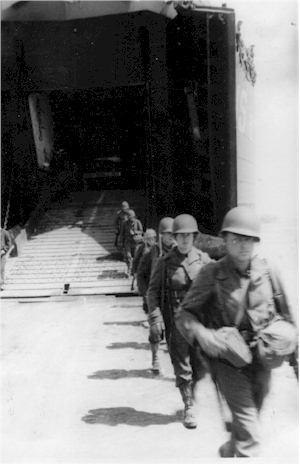
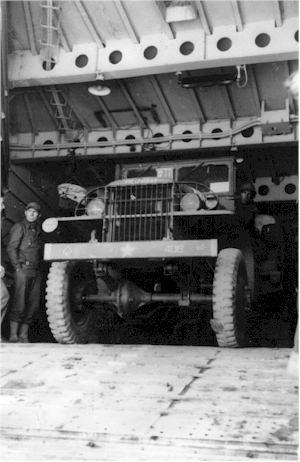
The next time was for real and not very pretty! These photos were taken by Truman Cummings, Navigator of the LST 50 until the end of the War. During the occupation he became the Skipper and the 50 was a mail ship. |
|
Note: Fabius was a Roman General who avoided meeting Hanibal in a full fledged battle but instead wore him down with skirmishes and eventually prevailed. He was a model for George Washington's strategy against the British.Copyright 2002, Joe Hagen, all rights reserved
Landingship.com © 2005-2026 Site by Dropbears